



Mutual Funds vs ETFs: Which Should You Invest In? Take Action Today!
Introduction
Investing is a critical aspect of financial planning, and choosing the right investment vehicle can significantly impact your financial outcomes. Among the popular options, mutual funds and exchange-traded funds (ETFs) stand out for their unique features and benefits. Understanding the distinctions between these two can guide you in making an informed decision that aligns with your investment goals and risk tolerance. This blog delves into the characteristics, pros, and cons of mutual funds and ETFs, providing a comprehensive comparison to help you decide which is the best fit for your portfolio.
Understanding Mutual Funds
Definition and Characteristics
A mutual fund is a pooled investment vehicle managed by a professional fund manager. It collects money from multiple investors to invest in a diversified portfolio of stocks, bonds, or other securities. The primary aim is to achieve financial returns through professional management and diversification. Each investor owns shares representing a portion of the holdings of the fund.
Types of Mutual Funds
Mutual funds come in various forms, each catering to different investment strategies and goals:
- Index Funds: These funds track a specific market index, such as the S&P 500, aiming to replicate its performance. They are passively managed and generally have lower fees.
- Actively Managed Funds: These funds are overseen by fund managers who actively make investment decisions to outperform the market. They typically come with higher fees due to the active management.
Pros and Cons of Investing in Mutual Funds
Pros:
- Professional Management: Investors benefit from the expertise of professional fund managers who make investment decisions on their behalf.
- Diversification: Mutual funds invest in a wide range of securities, reducing the risk associated with individual investments.
- Accessibility: With low minimum investment requirements, mutual funds are accessible to a broad range of investors.
Cons:
- Fees and Expenses: Mutual funds often charge management fees and other expenses, which can erode returns over time.
- Limited Control: Investors have no say in the selection of individual securities within the fund.
- Potential for Underperformance: Actively managed funds may underperform their benchmarks after accounting for fees.
Understanding ETFs
Definition and Key Features
An ETF is a type of investment fund traded on stock exchanges, much like stocks. It holds assets such as stocks, commodities, or bonds and operates with an arbitrage mechanism designed to keep its trading close to its net asset value.
Types of ETFs
ETFs are available in various categories to suit different investment needs:
- Equity ETFs: These funds invest in a basket of stocks and often track a specific index.
- Bond ETFs: These funds invest in a portfolio of bonds, providing exposure to fixed-income securities.
Pros and Cons of Investing in ETFs
Pros:
- Lower Expense Ratios: ETFs typically have lower management fees compared to mutual funds.
- Flexibility and Liquidity: ETFs can be bought and sold throughout the trading day at market prices, providing liquidity and flexibility.
- Tax Efficiency: Due to their structure, ETFs are generally more tax-efficient than mutual funds.
Cons:
- Trading Commissions: Buying and selling ETFs can incur brokerage commissions, which can add up for frequent traders.
- Potential Tracking Error: ETFs may not perfectly track the performance of their underlying index.
- Lack of Active Management: Most ETFs are passively managed, which might not appeal to investors looking for active management.
Key Differences Between Mutual Funds and ETFs
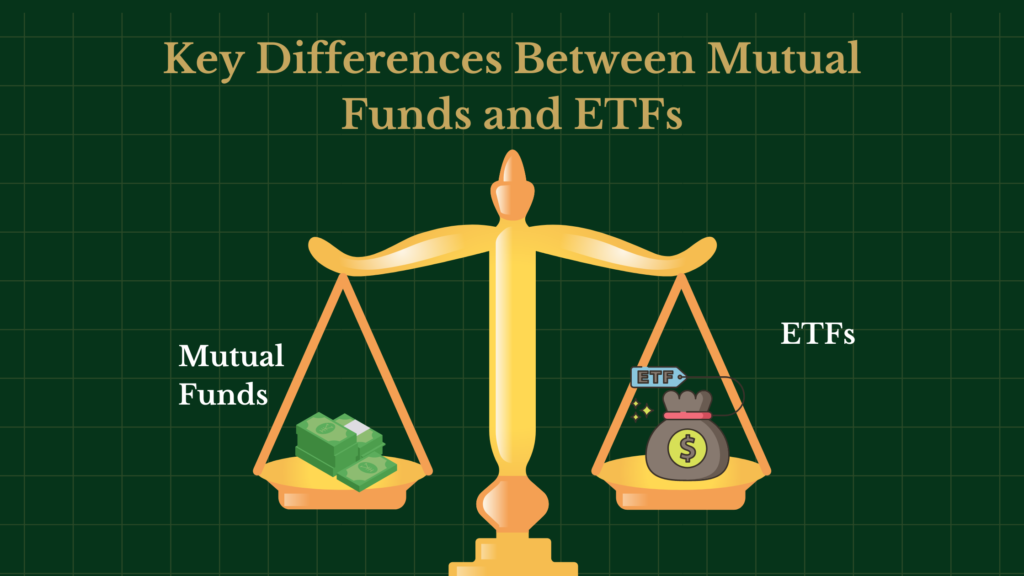
| Feature | Mutual Funds | ETFs |
|---|---|---|
| Structure and Operation | Pooled investment managed by professionals | Traded on exchanges, operates like stocks |
| Costs and Fees | Generally higher fees, including management expenses | Lower expense ratios, trading commissions may apply |
| Tax Implications | Potentially less tax-efficient | Generally more tax-efficient due to in-kind redemptions |
| Trading and Liquidity | Priced once daily, trades at NAV | Trades throughout the day at market prices |
Factors to Consider When Choosing Between Mutual Funds and ETFs
Investment Goals and Time Horizon
Understanding your investment goals and time horizon is crucial when choosing between mutual funds and ETFs. If you aim for long-term growth and prefer hands-off management, mutual funds, especially index funds, might be suitable. Conversely, if you seek flexibility and lower costs, ETFs could be the better option.
Risk Tolerance
Your risk tolerance should align with the investment vehicle you choose. Mutual funds offer a broad range of risk levels through various types of funds. ETFs also offer diverse options, from conservative bond ETFs to aggressive equity ETFs.
Expense Ratios and Fees
Fees and expenses can significantly impact your returns. Mutual funds generally have higher expense ratios due to active management. ETFs often have lower costs, making them attractive to cost-conscious investors.
Investment Strategy Preference
Your investment strategy plays a crucial role in this decision. If you prefer active management and are willing to pay higher fees for potential outperformance, mutual funds might be appropriate. For those who favor passive investing and lower costs, ETFs are typically the better choice.
Case Studies: Examples of Mutual Fund and ETF Investments
Scenario 1: Long-Term Retirement Savings
For long-term retirement savings, an investor might consider a diversified portfolio of mutual funds and ETFs. For instance, a mix of index mutual funds and broad-market ETFs can provide both diversification and cost efficiency.
Scenario 2: Short-Term Investment for Specific Goals
For a short-term investment, such as saving for a down payment on a house, an investor might opt for bond ETFs, which offer stability and liquidity. Alternatively, a conservative mutual fund can also serve this purpose.
Comparison of Investment Outcomes
By comparing the outcomes of investing in mutual funds and ETFs for these scenarios, investors can see the benefits and drawbacks of each option. Mutual funds may provide a more hands-off approach, while ETFs offer greater control and cost advantages.
How to Invest in Mutual Funds and ETFs
Opening a Brokerage Account
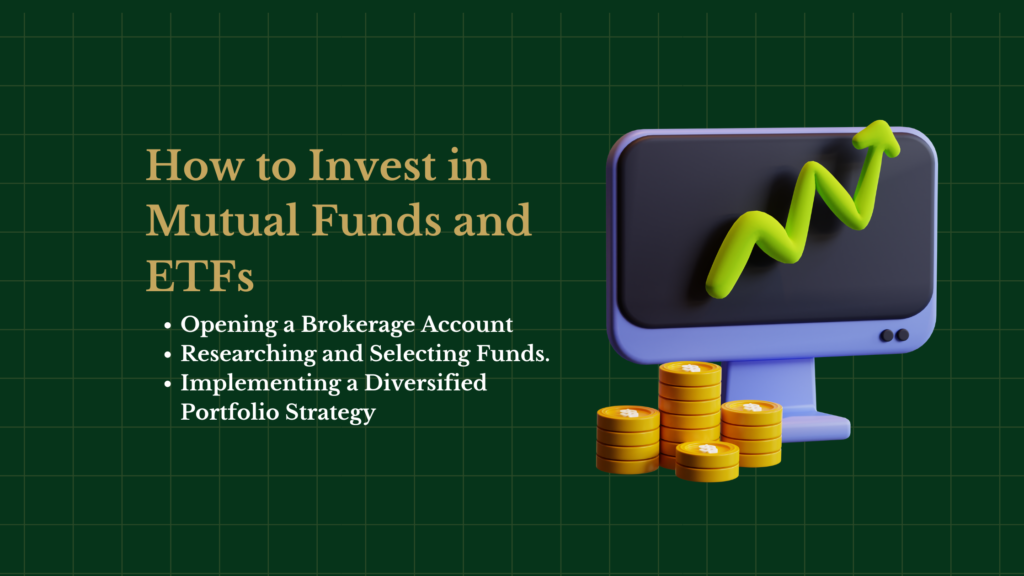
The first step to investing in mutual funds and ETFs is opening a brokerage account. Most online brokers offer a wide range of mutual funds and ETFs to choose from.
Researching and Selecting Funds
Conduct thorough research to select funds that align with your investment goals and risk tolerance. Consider factors such as expense ratios, historical performance, and the fund’s objective.
Implementing a Diversified Portfolio Strategy
Diversification is key to managing risk. Combine different types of mutual funds and ETFs to create a balanced portfolio that can weather market fluctuations.
Conclusion: Making Your Decision and Taking Action
Choosing between mutual funds and ETFs depends on your individual financial goals, risk tolerance, and investment preferences. By understanding the key differences and considering the factors outlined in this blog, you can make an informed decision. Evaluate your personal financial situation and take action by selecting the investment vehicle that best meets your needs.
Additional Resources and Further Reading
Recommended Books, Websites, and Tools
- The Little Book of Common Sense Investing by John C. Bogle
- A Random Walk Down Wall Street by Burton G. Malkiel
- Websites: Morningstar, Investopedia, and Vanguard
Glossary of Investment Terms
- Net Asset Value (NAV): The total value of a mutual fund’s assets minus its liabilities, divided by the number of outstanding shares.
- Expense Ratio: The annual fee that all mutual funds or ETFs charge their shareholders.
- Tracking Error: The difference between the performance of an index fund or ETF and the index it tracks.
FAQs about Mutual Funds and ETFs
Are ETFs better than mutual funds?
It depends on your investment goals and preferences. ETFs generally have lower costs and greater flexibility, while mutual funds offer professional management and a broad range of options.
How do I choose between a mutual fund and an ETF?
Consider factors such as your investment goals, risk tolerance, and preference for active vs. passive management.
What are the tax implications of investing in mutual funds vs. ETFs?
ETFs are generally more tax-efficient due to their structure, while mutual funds may incur higher capital gains distributions.
Can I invest in both mutual funds and ETFs?
Yes, many investors use a combination of both to diversify their portfolios and take advantage of the unique benefits of each.
What are the costs associated with mutual funds and ETFs?
Mutual funds typically have higher expense ratios and may charge sales loads, while ETFs have lower expense ratios but may incur trading commissions.